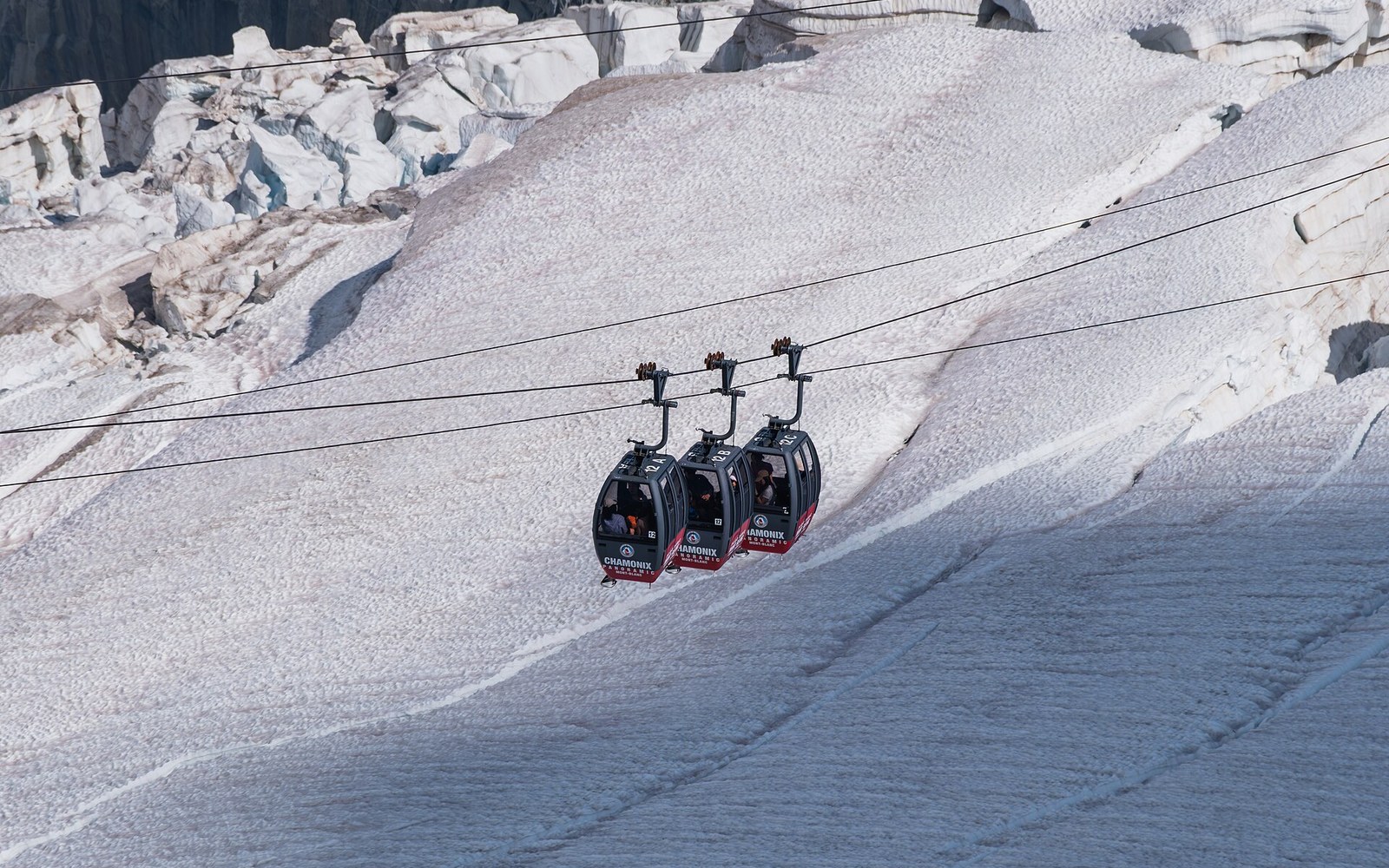
Two spans, one intermediate station, and a summit stop at 3,842 m.
Photo: Cable cars crossing crevassed glacier below Aiguille du Midi, Chamonix, Haute-Savoie · Wikimedia Commons
The Aiguille du Midi Cable Car and What It Required
A station cut into a pinnacle
The Aiguille du Midi rises to 3,842 metres above Chamonix, a needle of granite so steep that no conventional mountain railway could approach it. The answer arrived in two stages, completed in 1955: a téléphérique — an aerial cable car suspended from fixed cables — running not in a single span but in two, with an intermediate station at Plan de l'Aiguille at 2,317 metres. The lower span from Chamonix (1,035 m, IGN) to Plan de l'Aiguille was the simpler engineering task. The upper span, from Plan de l'Aiguille to the summit station at 3,842 metres, covered roughly 2.9 kilometres of horizontal distance and climbed more than 1,500 metres in a single flight. When it opened, the line was the highest cable car in the world, carrying passengers at an altitude where mountain weather can collapse with no warning.
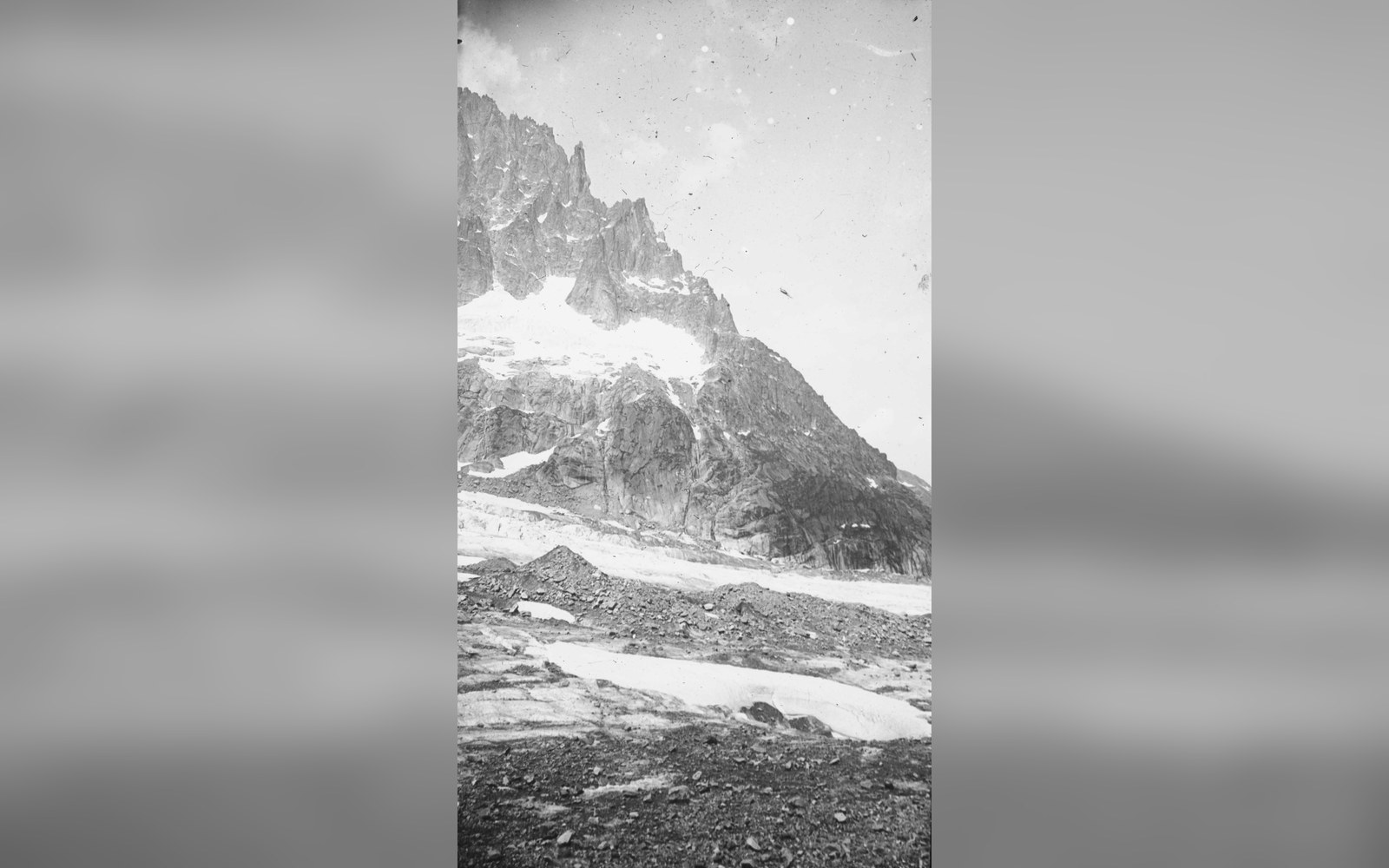
The Mer de Glace is read as a surface that carries its own measurements.
Photo: France - Alpes - Rhône-Alpes - Haute-Savoie - L’aiguille de la République vu depuis la Mer de Glace (MédiHAL 1270029) · Wikimedia Commons
The summit station was not placed on top of the Aiguille du Midi: it was cut into it. Engineers blasted and excavated chambers, corridors and a tunnel system directly into the granite pinnacle, then poured concrete into a structure that the rock itself had to anchor. The station occupies multiple levels inside the peak — machinery rooms, passenger areas, an observation terrace — all requiring that the building be integrated into the mountain rather than resting on it. The summit temperature drops well below freezing for most of the year, and the structure must accommodate the thermal expansion and contraction of metal cable components across temperature swings that can exceed 50 degrees Celsius between summer and winter operating conditions.
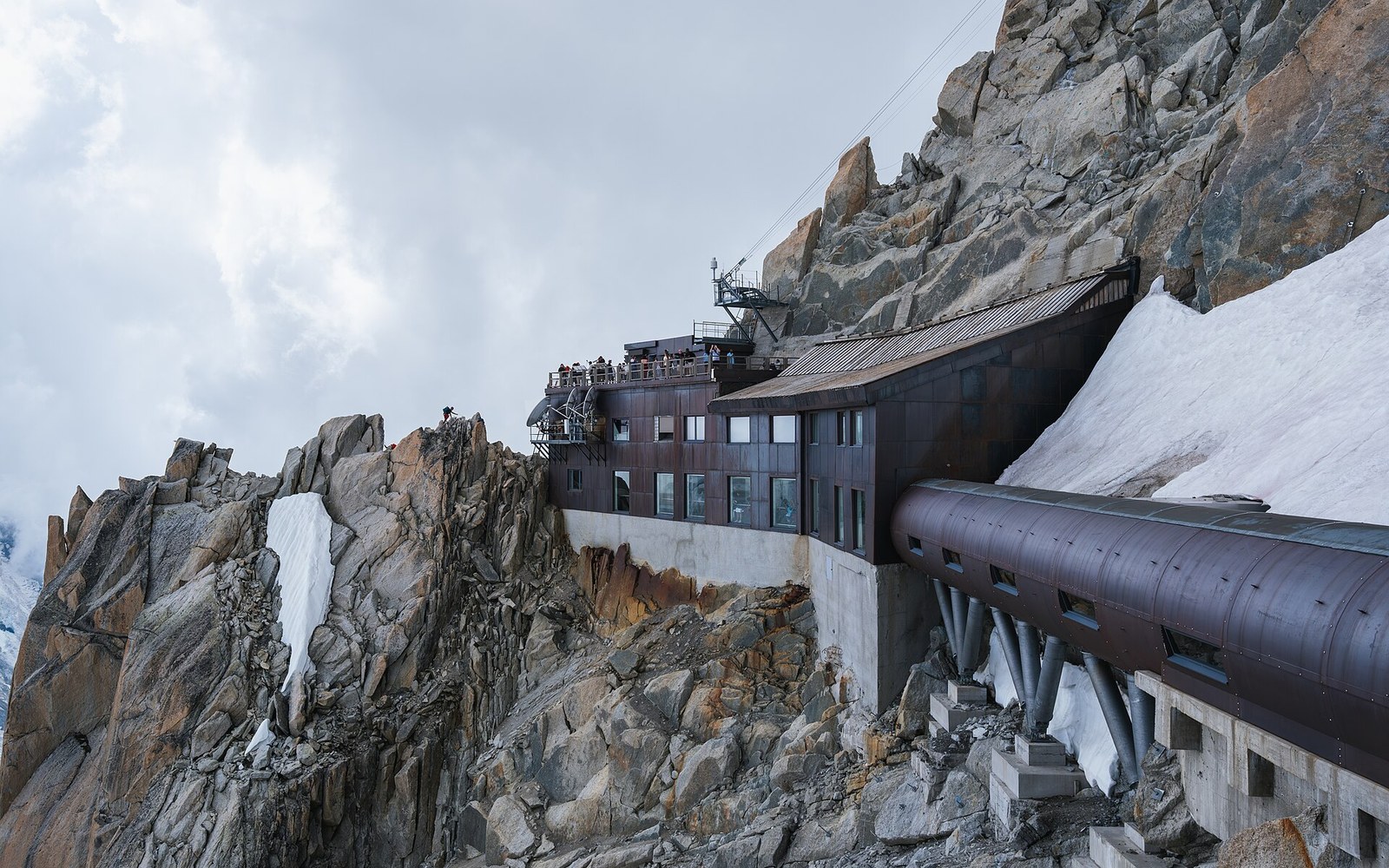
The summit station is cut into the pinnacle itself, at 3,842 m (IGN).
Photo: Aiguille du Midi summit station cliffside architecture, Chamonix, Haute-Savoie · Wikimedia Commons
The cable problem
Téléphérique engineering turns, above all, on the carrying and haulage cables. The upper span of the Aiguille du Midi system requires cables that can hold a loaded cabin against the wind loads found at that altitude while also managing the catenary sag across a span of that length. A longer, higher span means the supporting cable must be tensioned to enormous loads to keep sag — and therefore the cabin's oscillation — within acceptable limits. The intermediate station at Plan de l'Aiguille serves a second purpose beyond serving hikers accessing the mid-mountain terrain: it breaks the system into two mechanically independent spans, halving the maximum unsupported length and making the cable dimensions and anchor forces manageable with materials then available.
Construction on the current system, which replaced earlier and more limited infrastructure, began in the early 1950s. The line was completed and opened to the public in 1955. The pylons on the lower section are conventional lattice steel towers founded on rock. On the upper span, the geometry of the Aiguille du Midi itself eliminates any possibility of a mid-span pylon; the cables must make the crossing without intermediate support. The anchor points at the summit are embedded in granite under enormous tension loads, transferred to the rock through a system of steel bolts and grouted anchors driven into the pinnacle during the construction excavations.
The cabin capacity on the current system allows around sixty-five passengers per cabin. The journey from Chamonix to the summit, with the change of cabin at Plan de l'Aiguille, takes approximately twenty minutes in total. Operational management sits with the Compagnie du Mont Blanc, the body that also coordinates the Montenvers rack railway and other mechanical lifts in the Chamonix massif. The infrastructure has been upgraded since 1955 — cabins, drive machinery and cable systems have been renewed in subsequent decades — but the fundamental engineering solution remains the one the original builders chose: two spans, one intermediate station, and a terminal carved into the rock of the summit itself.
Key figures
| Chamonix valley station altitude | 1,035 m (IGN) |
|---|---|
| Plan de l'Aiguille intermediate station | 2,317 m |
| Aiguille du Midi summit station | 3,842 m (IGN) |
| Total vertical gain, valley to summit | approximately 2,807 m |
| Upper span length | approximately 2.9 km horizontal, no mid-span pylon |
| System completed and opened | 1955 |