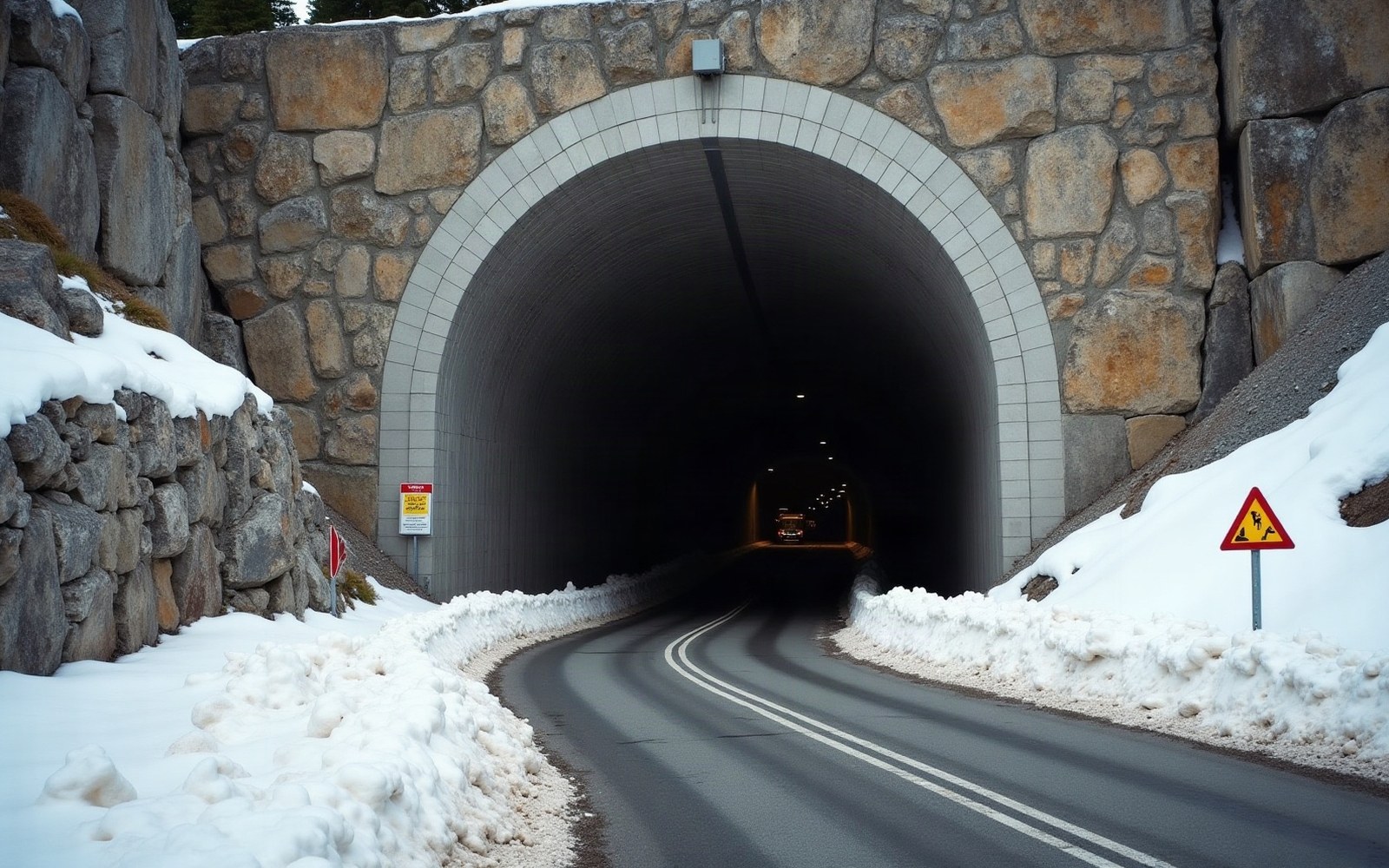
A portal driven into the rock face, snow banked at the mouth. The valley has two of them.
Modane Twice Over: Rail 1871, Road 1980
Two bores through the same massif, a century apart — each the longest of its kind when it opened, each reshaping the Maurienne's relationship with the peninsula beyond.
The First Bore: Mont Cenis and the Problem of the Alps
The tunnel that opened on 17 September 1871 between Modane and Bardonecchia is commonly called the Mont Cenis Tunnel, though it passes nowhere near the Mont Cenis plateau — the name belonged to the old coach route it made redundant, and it stuck. Its correct designation is the Fréjus Rail Tunnel, and at 13.6 kilometres it was, on the day it opened, the longest railway tunnel in the world. The Société des Chemins de Fer de Paris à Lyon et à la Méditerranée had been pushing lines southward for years; this was the obstacle that required an entirely different order of engineering.
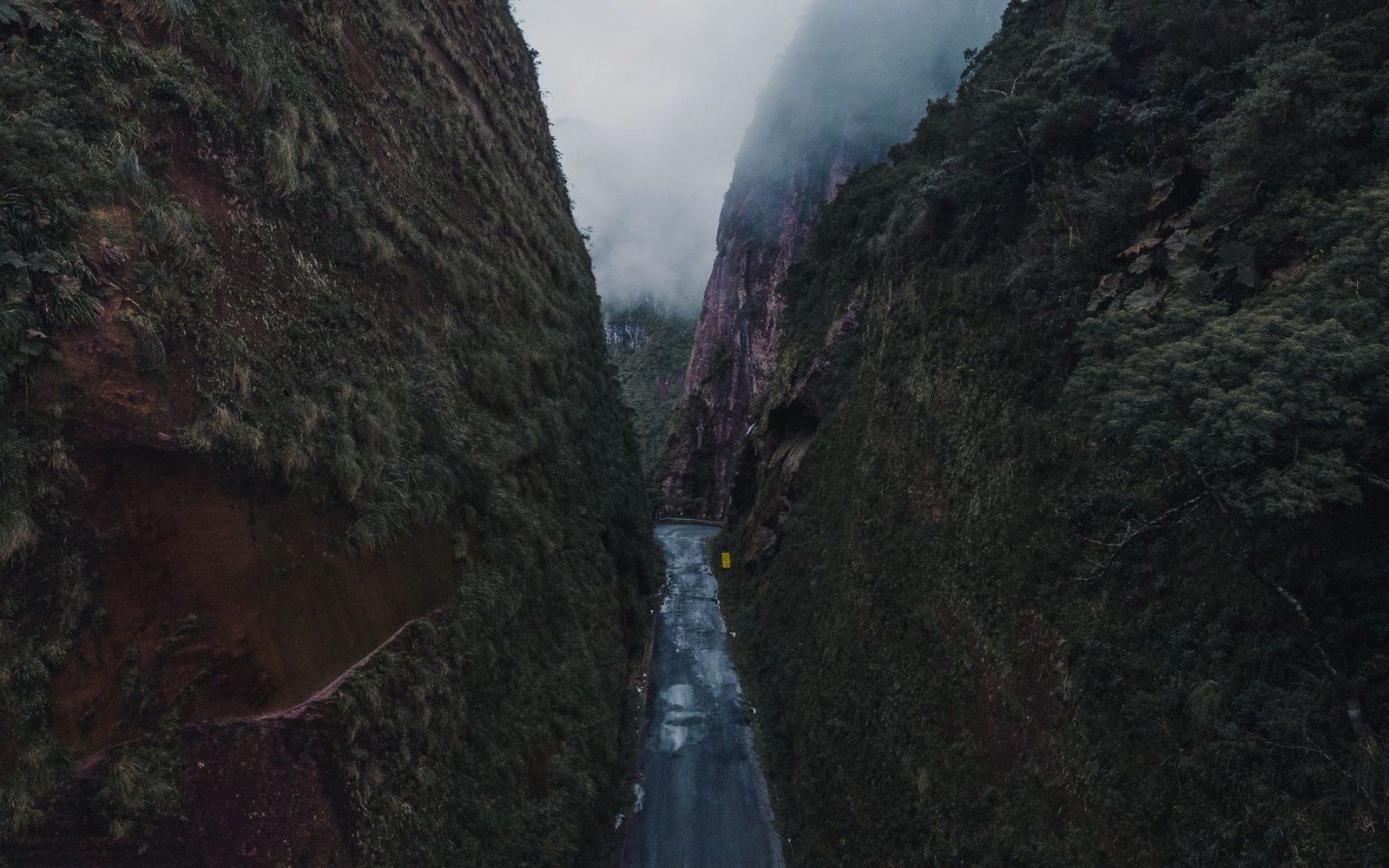
The Arc has cut its bed so deep that road and rail compete for the same ledge.
Photo: Guilherme Rossi / Pexels
Work began in 1857 under a venture of the Kingdom of Sardinia (Piedmont-Sardinia) — Savoy had not yet been ceded to France. The challenge was not distance alone but the depth of the overburden: at its deepest point the tunnel passes some 1,800 metres below the mountain surface, and neither ventilation nor drainage had ever been solved at that scale. The solution to the first problem was mechanical: the engineer Germain Sommeiller designed a pneumatic rock drill powered by compressed air, feeding the drills from water-pressure accumulators charged by streams on the Italian side. Sommeiller's pneumatic percussion drill ↗ was among the first practical applications of compressed air in tunnel excavation, and it cut the projected construction time roughly in half. Even so, the work consumed fourteen years and the lives of several dozen workers before the two headings met.
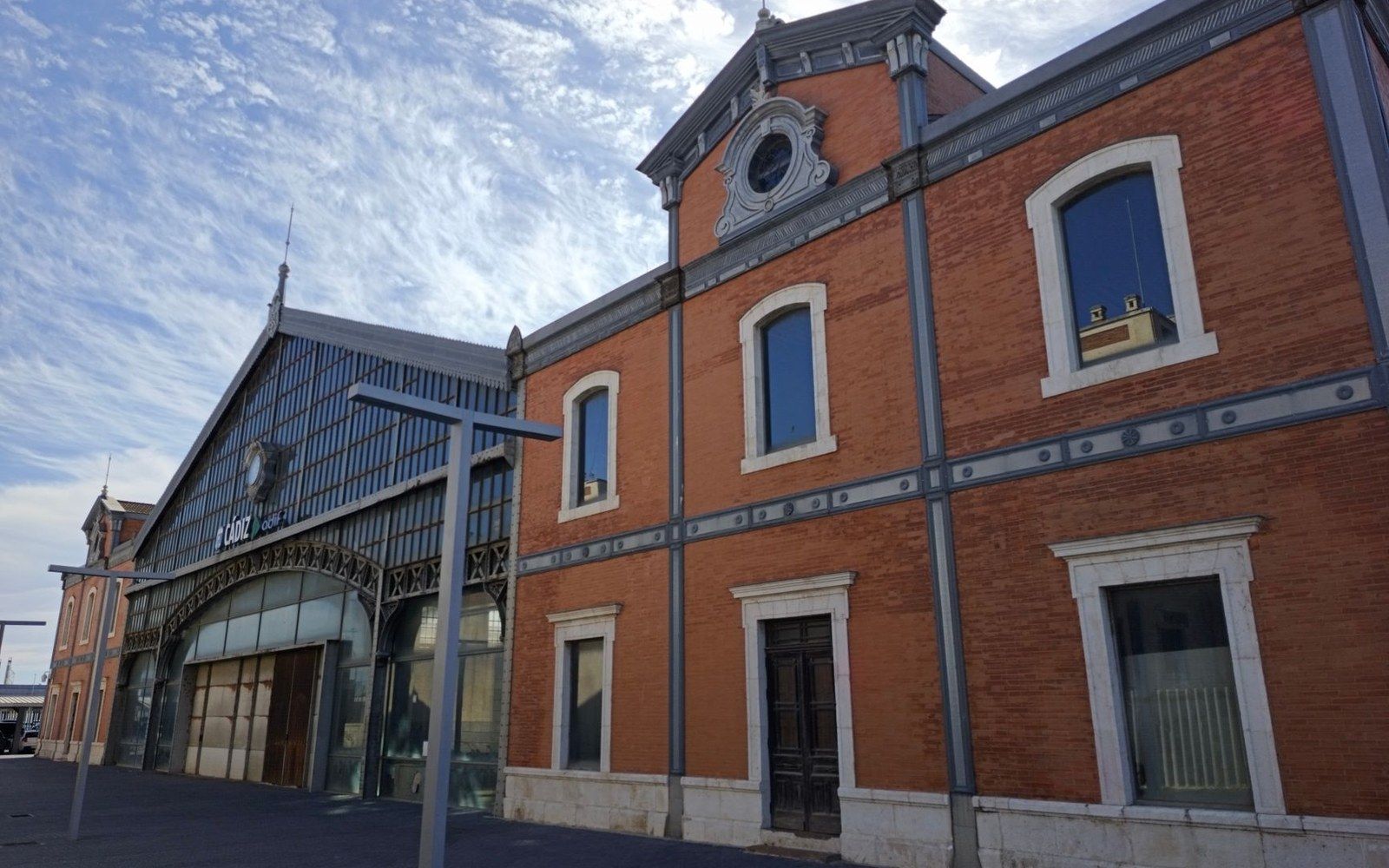
A station built for a pause: locomotives changed here, and so did the voltage.
Photo: Antonio Garcia Prats / Pexels
What the tunnel changed was direct and immediate. Traffic between Lyon and Turin, previously a multi-day crossing by coach over the Col du Mont Cenis — a journey that shut down entirely in bad winters — became a through rail journey of manageable hours. The Maurienne valley shifted from a transit corridor that travellers endured into a corridor they barely noticed: trains passed through it in the dark. For Modane itself the effect was structural. The frontier station expanded on both administrative and physical grounds; the town acquired customs infrastructure, locomotive servicing facilities and the particular economy of a railhead. The change of system imposed by the border — locomotives, and later electrical voltage, differed — meant that trains were broken apart at Modane and reassembled, employment that lasted through the twentieth century.
The broader consequence for the Maurienne was freight. Goods moving between France and Italy no longer needed teams of mules and a season-dependent road. Industrial traffic through the valley — coal, textiles, later the ores and aluminium that the Arc's hydroelectric capacity would eventually attract — relied on the 1871 bore for over a century before any road alternative existed.
The Second Bore: A Parallel Tunnel, a Different Century
The Fréjus Road Tunnel, which opened on 12 July 1980, is about 12.9 kilometres long, making it among the longest road tunnels in the world when it opened ↗. It too runs between Modane and Bardonecchia. The two tunnels are not coaxial — they sit roughly 200 metres apart in the rock — but they pass through the same geological formation, the crystalline schists and gneiss of the Fréjus massif, and they were bored by recognisably similar methods: drilling and blasting at the face, rail haulage of spoil, continuous concrete lining poured behind advancing works. Construction began in 1974 and took six years. The engineering challenge this time was less ventilation — though the road tunnel required a purpose-built transverse ventilation system, with fresh air injected at intervals and exhaust extracted separately — than it was the management of the great thickness of rock overhead and unpredictable groundwater.
The gallery does not stop the avalanche; it lets it pass over the carriageway.
Photo: Francesco Ungaro / Pexels
The tunnel was a joint French-Italian project, administered through a bi-national company, SFTRF on the French side (Société Française du Tunnel Routier du Fréjus). Its opening was deliberately timed: the 1980 winter season was less than a year away, and the argument made in both countries was that road freight between France and Italy should not remain dependent on mountain passes that shut seasonally. The Mont Blanc Tunnel ↗, which had opened in 1965, had proven the model: a road bore could sustain year-round heavy goods traffic at a scale no pass road permitted.
What changed in 1980 was the texture of industrial movement through the Maurienne. Rail had dominated trans-Alpine freight for over a century; road haulage now had a competitive route. Truck volumes through the Fréjus Road Tunnel grew rapidly through the 1980s and 1990s, bringing with it the familiar costs of that growth — congestion, pollution in a narrow valley with limited dispersion, and the political argument, not yet settled, about whether the Alps should absorb unlimited road freight or redirect it back to rail. A fire in the Mont Blanc Tunnel in 1999 that killed 39 people triggered new safety reviews across all Alpine road tunnels; the Fréjus tunnel was temporarily closed, and when it reopened traffic was regulated by alternating direction flows and new safety refuge chambers built into the bore at regular intervals.
Two Structures, One Massif
The spatial relationship between the two tunnels is closer than most travellers realise. At the Modane portal, rail and road emerge within a few hundred metres of each other, and the infrastructure serving both — the freight yards, the ventilation buildings, the maintenance access corridors — occupies a compact wedge of ground between the Arc river and the mountain wall. The rock separating the two bores was surveyed carefully during road-tunnel construction to ensure that blasting on the road heading did not stress the lining of the 1871 rail bore. A drainage and monitoring gallery connects sectors of the two tunnels, allowing inspection of shared geological zones.
The century between the two openings is, in effect, a record of what Alpine engineering could attempt and what it could afford. Sommeiller's compressed-air drills were the limit of the possible in 1857; by 1974 hydraulic jumbos with multiple drill heads and computerised blast planning had made 13-kilometre bores a matter of logistical rather than mechanical difficulty. The rock was the same. The tools were a different civilisation. And Modane, sitting at both portals, accumulated the functions of both: a frontier town, a rail town, and finally a road town, the valley's gateway rendered in stone and concrete across two separate centuries.
Chronology
- 1857Construction begins on the Fréjus Rail Tunnel (then under Sardinian-Piedmontese jurisdiction)
- 17 September 1871Rail tunnel opens; 13.6 km, longest railway tunnel in the world at the time
- 1965Mont Blanc Tunnel opens, establishing the model for Alpine road bores
- 1974Construction begins on the Fréjus Road Tunnel
- 12 July 1980Road tunnel opens; about 12.9 km
- 1999Mont Blanc Tunnel fire (39 deaths) triggers safety revision across Alpine road tunnels; Fréjus Road Tunnel temporarily closed and subsequently upgraded