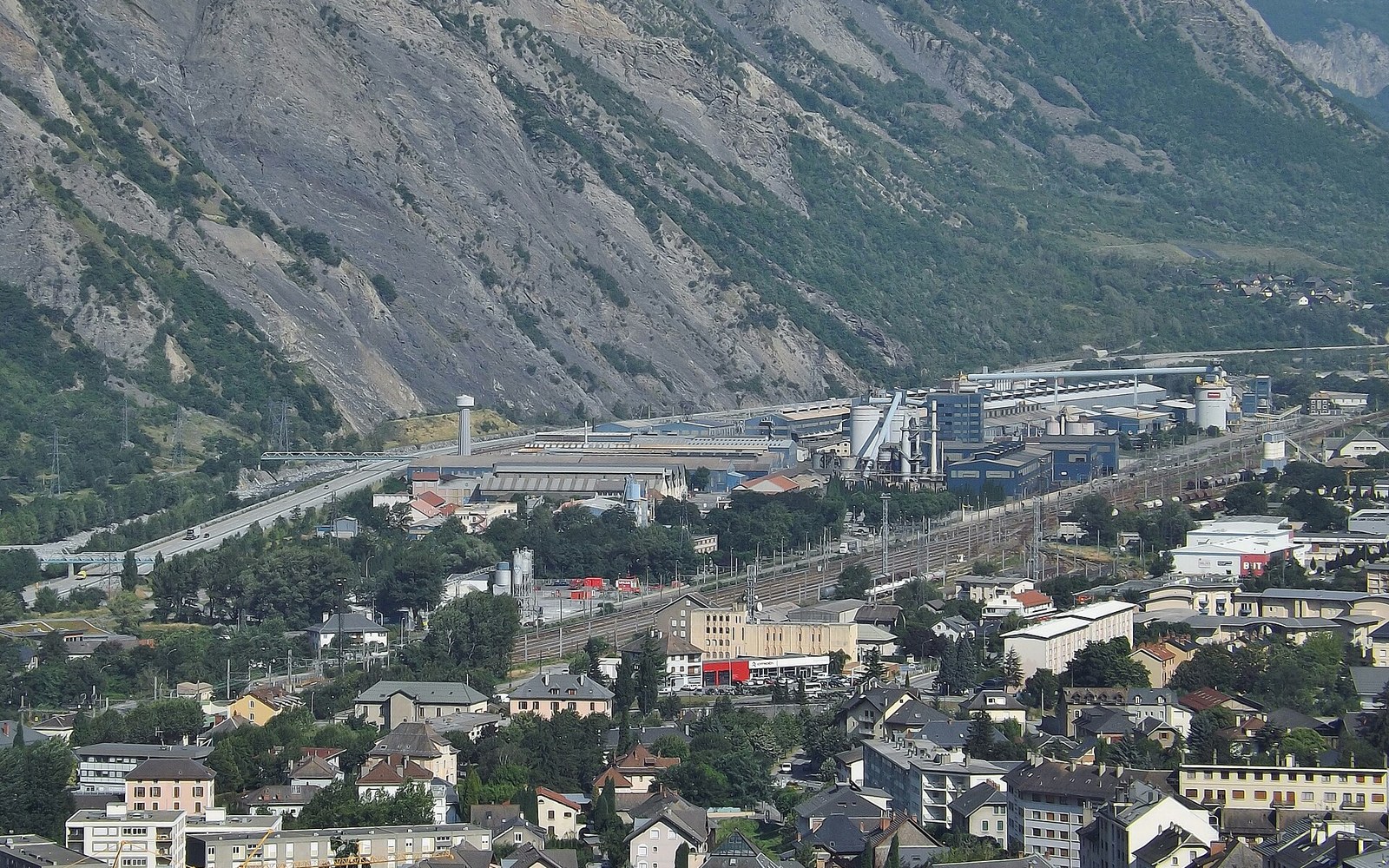
The smelters sit on the valley floor because that is where the current is cheapest.
Photo: Rio Tinto Alcan (Saint-Jean-de-Maurienne) · Wikimedia Commons
Why the Smelters Came to the Valley Floor
The Arc did not invite industry. The Arc's gradient did.
The Logic of Cheap Electrons
Aluminium smelting is, at its core, an electricity problem. The Hall-Héroult process — patented independently in 1886 — dissolves alumina in molten cryolite and passes a continuous direct current through the bath to free pure aluminium metal. A single tonne of aluminium consumes roughly 13 to 15 megawatt-hours of electricity. For that process to be commercially rational, power must be not merely available but exceptionally cheap. Cheap power, in the late nineteenth and early twentieth centuries, meant one thing in the French Alps: falling water.
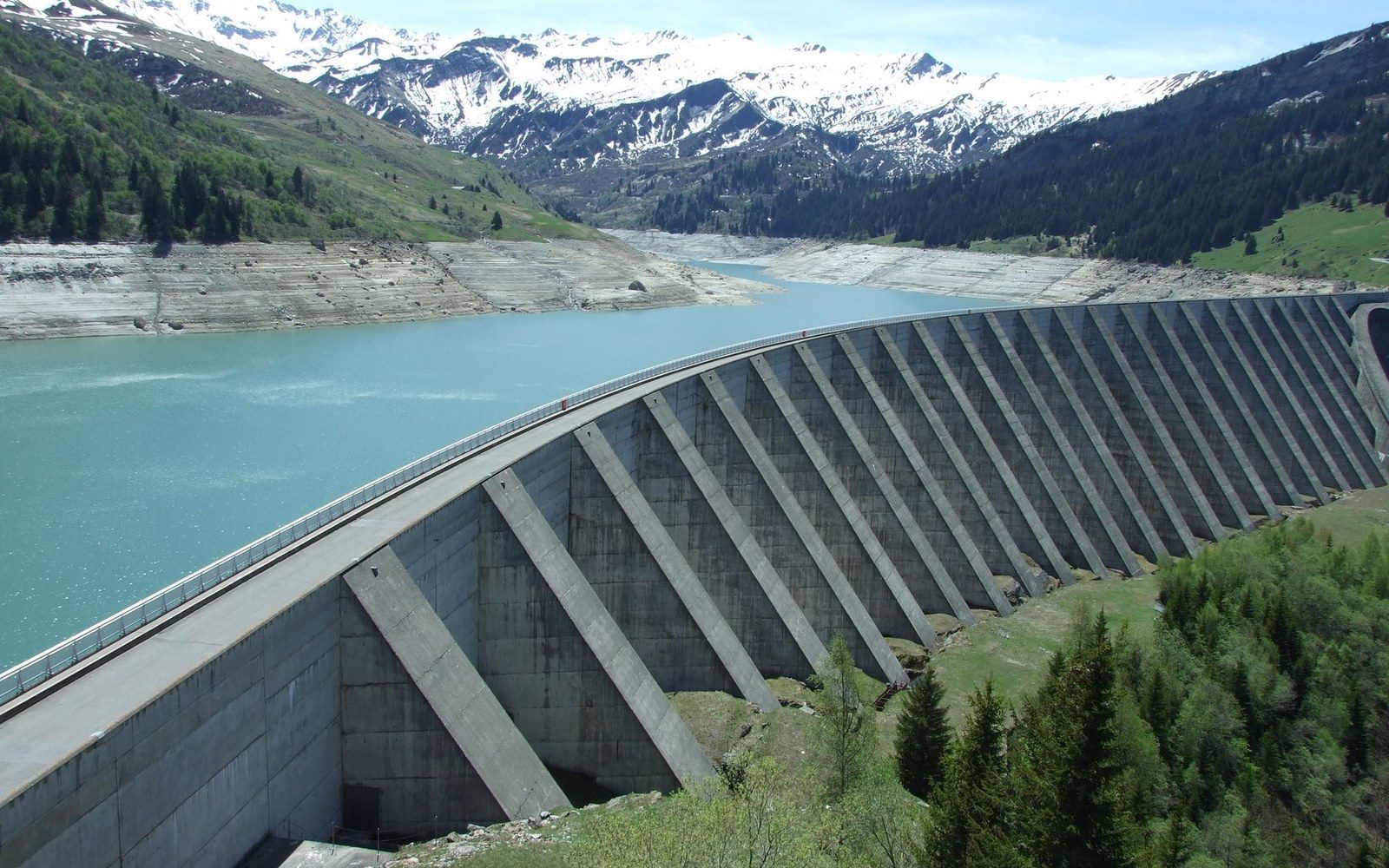
The Chevril wall stands 180 m. The old village is behind it, under the water.
Photo: ciboulette / Pexels
The Arc drops more than 1,800 metres from its source near the Col de l'Iseran to its confluence with the Isère at Aiton, doing so over roughly 125 kilometres of narrow valley — one of the steepest sustained gradients of any major Alpine river, as documented in IGN topographic surveys. That gradient translates directly into hydroelectric head: the vertical fall that turbines can exploit. Engineers arriving in the Maurienne in the first decade of the twentieth century were not discovering scenery; they were reading a power balance sheet.
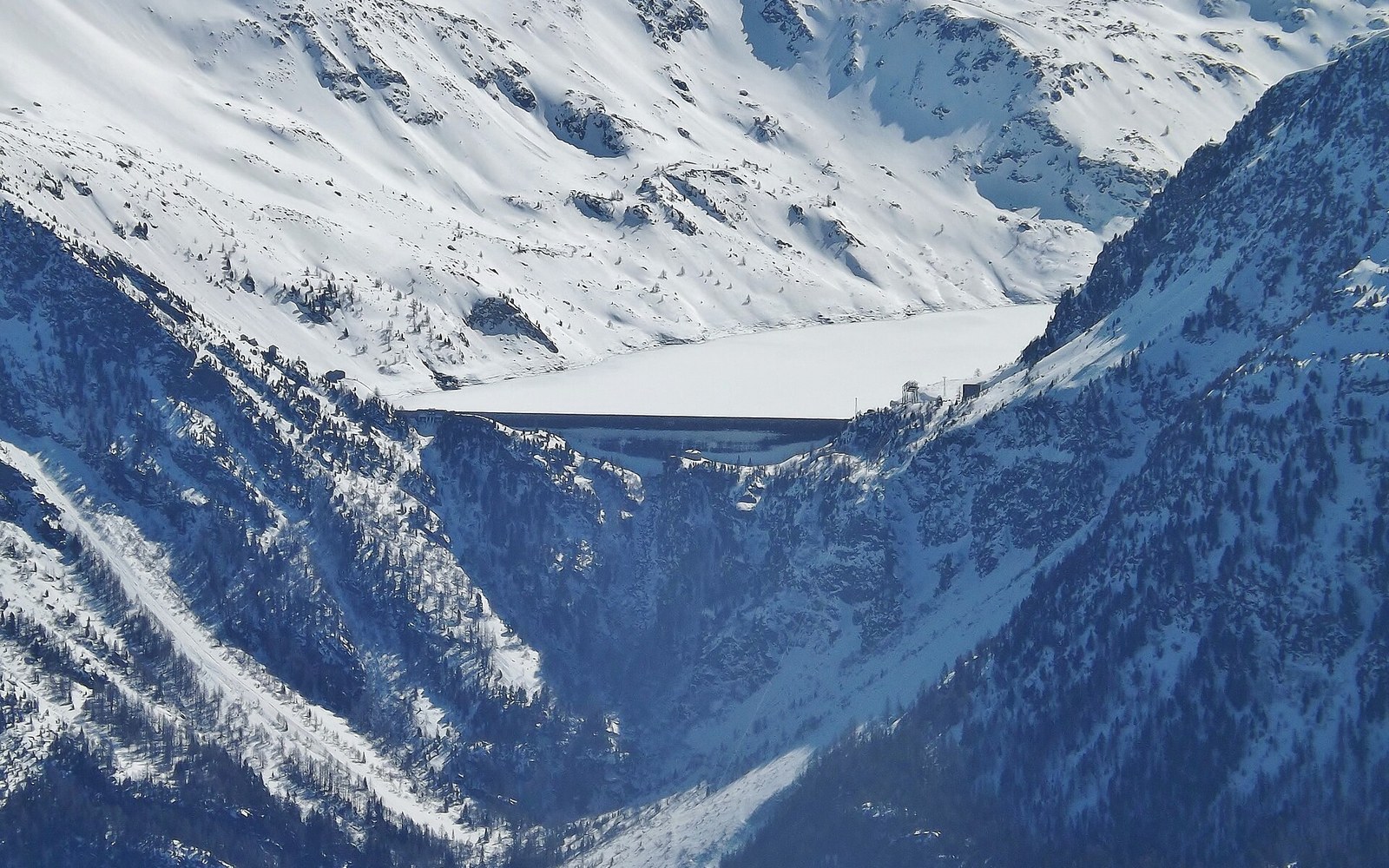
Bissorte, above the Maurienne. The gradient is the asset.
Photo: Barrage de Bissorte (hiver 2014) · Wikimedia Commons
From Dam to Potroom
The first significant hydroelectric installations on the Arc date from before the First World War, feeding the ambitions of the emerging electrochemical and electrometallurgical industries that were simultaneously colonising comparable valleys in Norway and Switzerland. Ugine, in the neighbouring Arly valley, and Saint-Jean-de-Maurienne, the valley's historic capital, both became nodes in this network. The Péchiney company — by then the dominant force in French aluminium production — developed smelting capacity in the Maurienne through the interwar decades, tying plant location systematically to the availability of contracted hydroelectric power.
At La Praz, near Modane, and at Saint-Jean-de-Maurienne, the characteristic industrial architecture of the potroom — long, low sheds housing hundreds of electrolytic cells — settled into the valley floor precisely because the valley floor is where the penstocks, the pressure pipes descending from upland reservoirs, delivered their power. The relationship was not incidental. Électricité de France, nationalised in 1946, subsequently rationalised and expanded the Arc's generating infrastructure, and the contracted industrial tariffs that made Maurienne aluminium competitive into the postwar decades were a direct expression of the river's geography made policy.
The grand postwar dam-building programme reinforced the logic rather than creating it. The dams of the upper Arc valley and its tributaries, and the broader Arc–Isère hydroelectric cascade brought installed capacity across the watershed to a scale that could anchor large-scale industry. According to EDF's published history of the Arc–Isère complex ↗, the valley system became one of the most intensively exploited hydroelectric corridors in metropolitan France.
The Chevril wall stands 180 m. The old village is behind it, under the water.
Photo: ciboulette / Pexels
What Geography Decided
The decision to smelt aluminium in the Maurienne rather than, say, beside a coalfield was never a decision in the conventional industrial sense. Geography decided first. Bauxite, the ore from which alumina is refined, came from deposits in Provence and later from imported sources; it arrived by rail and by the valley road. What the Maurienne supplied was the one input that could not be imported cheaply: electricity generated from a river that falls fast and falls far.
The smelters that defined the valley floor's industrial identity through most of the twentieth century — their potrooms, their power substations, their company housing — were a legible consequence of physical geography rendered into infrastructure. The Hall-Héroult process ↗ tied aluminium permanently to places where electricity was cheap enough to dissolve the economics of distance, and the Arc, by its gradient and its dams, was precisely such a place. That is why the smelters came to the valley floor: they followed the cheapest electrons in France.
Chronology
- 1886Hall-Héroult process patented independently by Charles Martin Hall and Paul Héroult
- Pre-1914first significant hydroelectric installations on the Arc operational
- 1946nationalisation of electricity generation; EDF established
- 1950sAussois/Doron de Bessans dams completed, expanding Arc watershed capacity