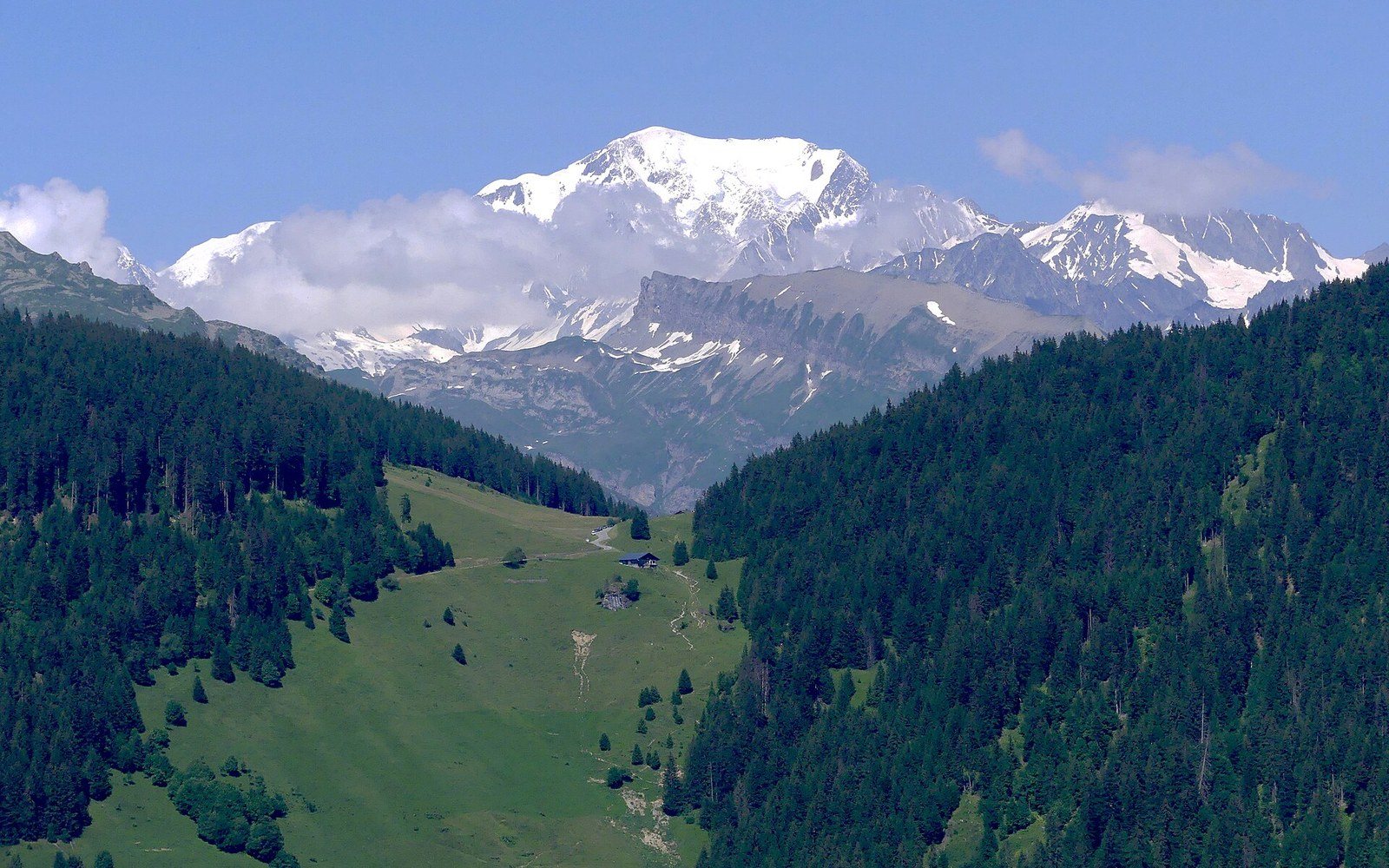
4,808 m. Balmat and Paccard went up on 8 August 1786 and came back down.
Photo: Col du Pré et Mont-Blanc depuis plateau de Cuvy en été (juillet 2024) 2 · Wikimedia Commons
Balmat and Paccard, 8 August 1786
The first ascent of Mont Blanc settled one question about altitude and opened a longer argument about who deserved the credit.
The Climb and Its Record
On 8 August 1786, Jacques Balmat, a crystal-hunter and chamois guide from Chamonix, and Michel-Gabriel Paccard, the village's resident physician, reached the summit of Mont Blanc ↗ at an elevation measured by the Institut Géographique National at 4,808 metres. The ascent began from the Chamonix valley on 7 August, with a night spent on the mountain before the summit push, following a line up the Montagne de la Côte, across the Glacier des Bossons and up to the Grand Plateau. No support party accompanied them. They carried the instruments of the period: a barometer for estimating altitude by atmospheric pressure, a thermometer, and a telescope so that observers in Chamonix — including the Geneva naturalist Horace-Bénédict de Saussure, who had been offering a prize for the ascent since 1760 — could confirm the summit was reached.
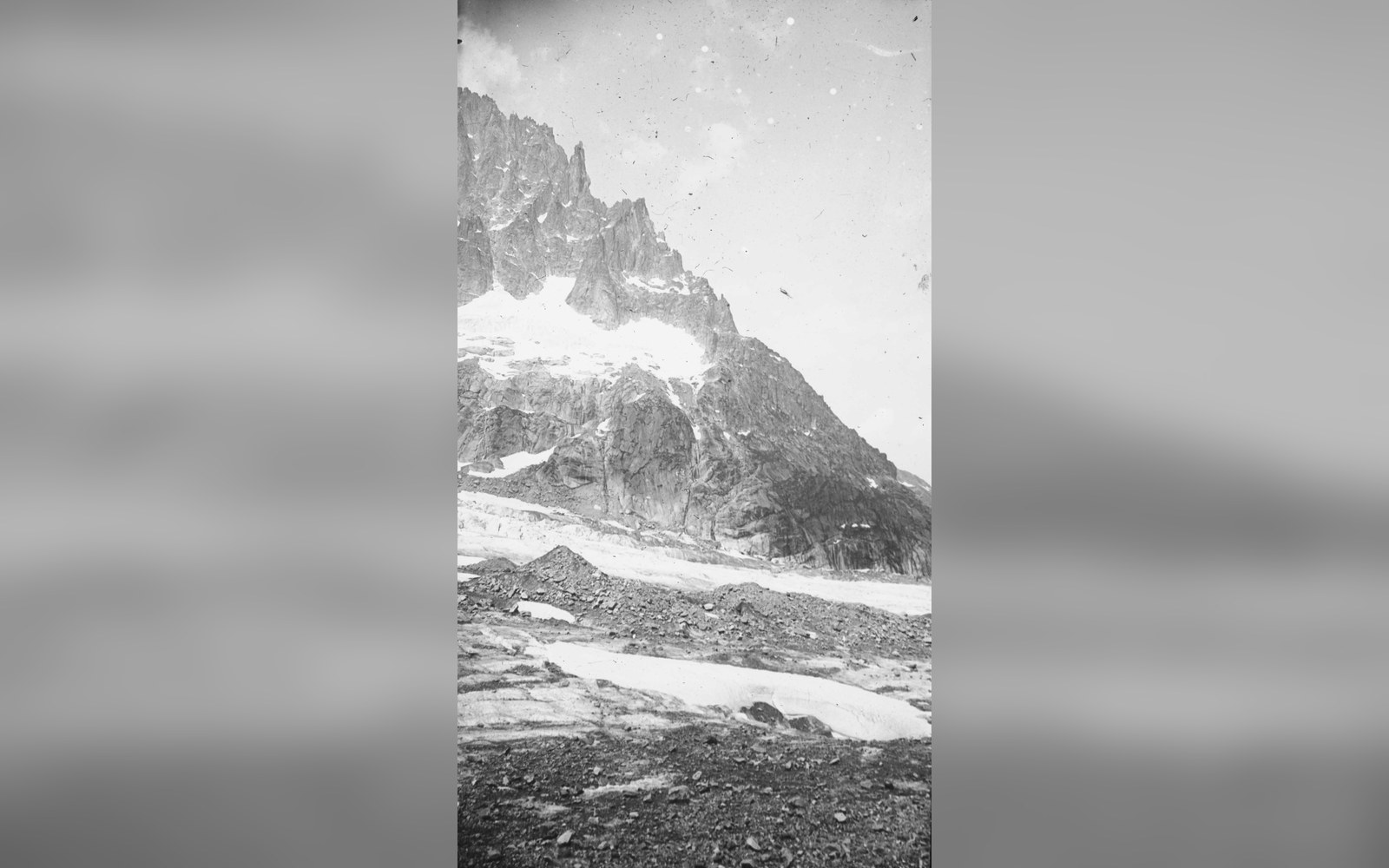
The Mer de Glace is read as a surface that carries its own measurements.
Photo: France - Alpes - Rhône-Alpes - Haute-Savoie - L’aiguille de la République vu depuis la Mer de Glace (MédiHAL 1270029) · Wikimedia Commons
They stood on the top for roughly half an hour. Paccard took readings; the barometer recorded data later used to calculate summit air pressure. Both men suffered the visible effects of altitude: impaired coordination, slowed movement and, in Paccard's case, temporary snow-blindness during the descent. These were not interpreted immediately as symptoms of what would later be called acute mountain sickness, but Paccard's notes constitute an early empirical record of physiological response to altitude above 4,500 metres.
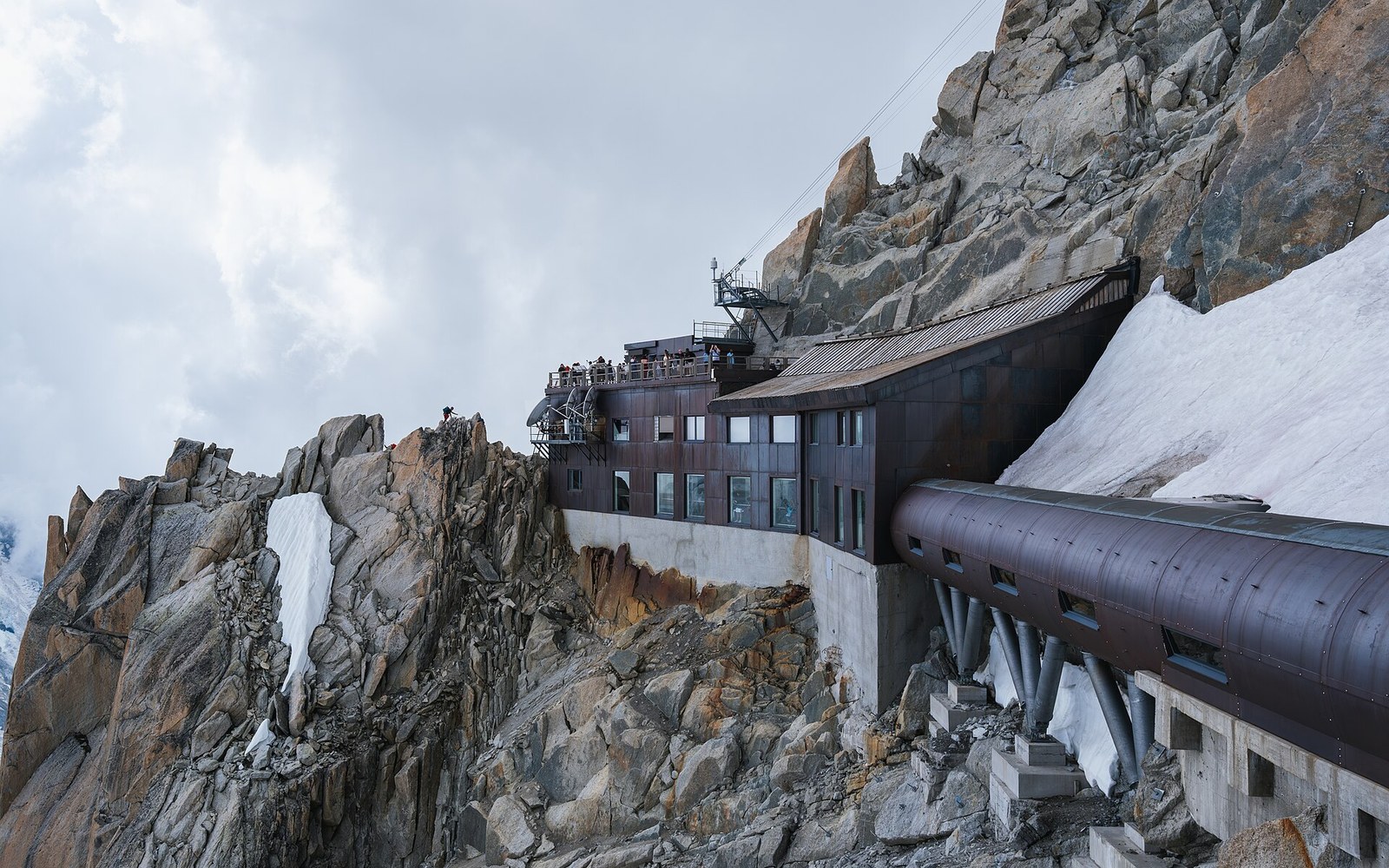
The summit station is cut into the pinnacle itself, at 3,842 m (IGN).
Photo: Aiguille du Midi summit station cliffside architecture, Chamonix, Haute-Savoie · Wikimedia Commons
The Dispute That Followed
The priority dispute began almost immediately. De Saussure's prize had been claimed, but the question of who led the ascent — and whose intellectual contribution warranted the greater share of credit — was contested within weeks. The account that circulated most widely in the years that followed, partly through the influence of the explorer and writer Marc-Théodore Bourrit, elevated Balmat's role and diminished Paccard's, portraying the physician as exhausted and near-helpless on the upper mountain. Subsequent researchers, working from Paccard's original diary and telescope observations made from the valley ↗, found no support for that picture.
The historian T. Graham Brown and Gavin de Beer examined the primary sources in detail in the mid-twentieth century and concluded that both men reached the summit under their own power, that Paccard took the scientific readings, and that the disparaging version of events owed more to Bourrit's longstanding rivalry with Paccard than to eyewitness testimony. The rebalancing of the historical record is now broadly accepted in Alpine scholarship, though the statue erected in Chamonix in 1887 — a century after the event — shows Balmat pointing the way while de Saussure looks on, with Paccard absent from the monument entirely.
What 1786 Established
The ascent's scientific value lay in its data. The barometric readings taken at the summit contributed directly to early calibrations of altitude-pressure relationships. De Saussure's own ascent the following year, in 1787, expanded this work substantially, but the baseline was Paccard's 1786 readings. The equipment both men used — leather boots, wool clothing, wooden-handled ice axes of the period, a basic rope — defined the absolute upper limit of what mid-eighteenth-century gear could sustain. The summit temperature recorded on 8 August 1786 was below freezing despite the summer date, a finding consistent with the lapse rate the IGN and later meteorological services would formalise for the western Alps.
What the ascent did not do is often misread. It did not open Mont Blanc to general passage: the approach from Chamonix remained difficult, technically demanding and genuinely hazardous for another generation. What it proved, precisely and on record, was that the highest point in the Alps was reachable by two men from the valley below it, carrying barometers.
Chronology
- 1760De Saussure announces prize for the first ascent of Mont Blanc
- 8 August 1786Balmat and Paccard reach the summit; Paccard takes barometric readings
- 1787De Saussure makes his own ascent, extending the physiological and meteorological record
- 1887Chamonix monument erected; Paccard absent from the sculpture