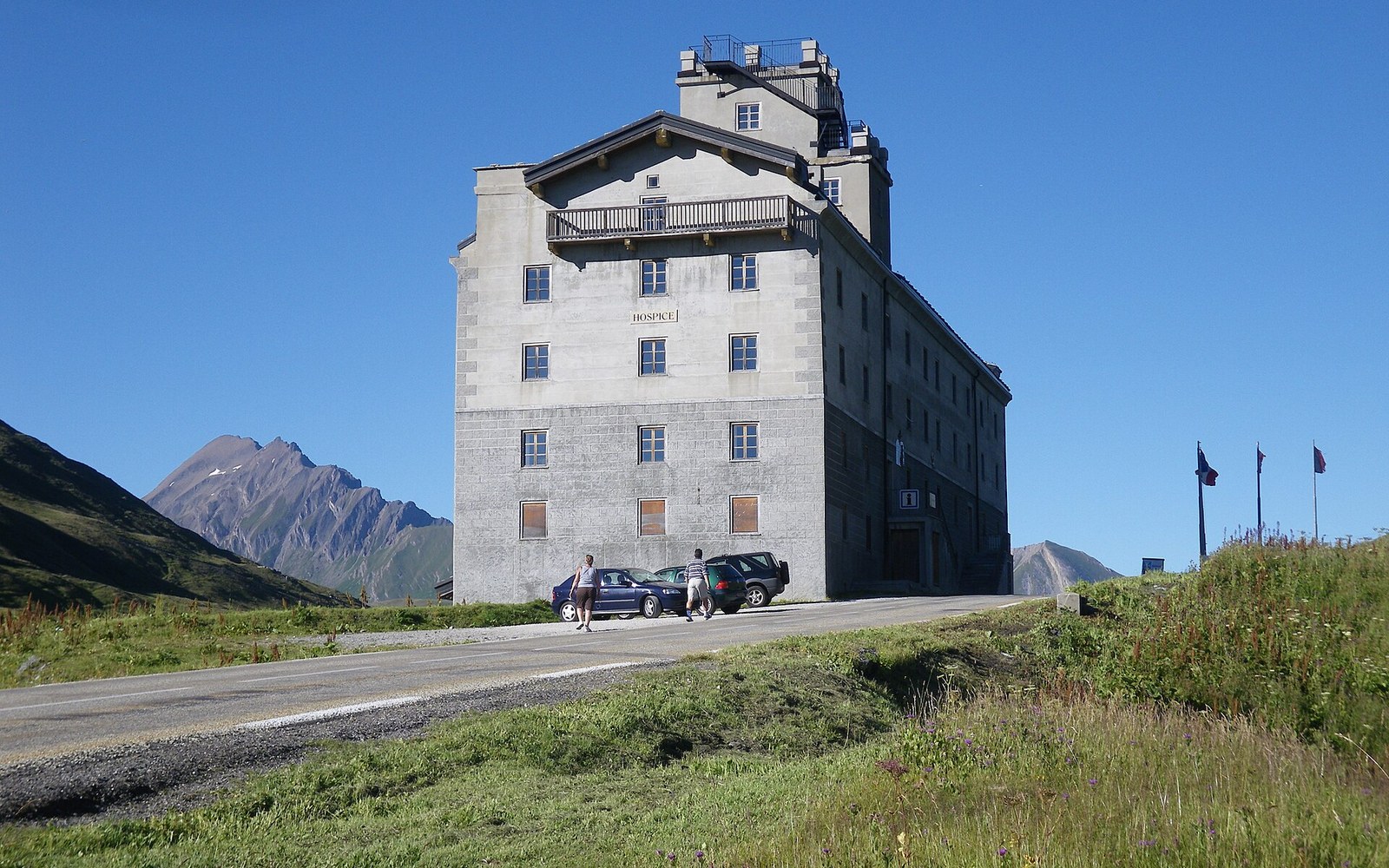
The hospice on the saddle: shelter first, then a claim on the crossing.
Photo: L'ancien hospice du col du petit saint bernard - panoramio · Wikimedia Commons
Petit Saint-Bernard: One Pass, Three Layers of Claims
A col at 2,188 metres that Romans, a medieval saint and a Carthaginian general have all been made to cross — not always with convincing evidence.
The Ground Itself
The Petit Saint-Bernard ↗ sits at 2,188 metres on the ridge that now marks the Franco-Italian border, connecting the upper Tarentaise valley on the French side to the Val d'Aoste below. The Institut Géographique National records it as the lower of the two Saint-Bernard passes; the Grand Saint-Bernard, carrying the main Swiss route, lies some eighty kilometres to the north. What the Petit Saint-Bernard offers is a relatively broad, open saddle — by alpine standards it is not a brutal crossing. That accessibility has made it historically attractive, and historically contested.
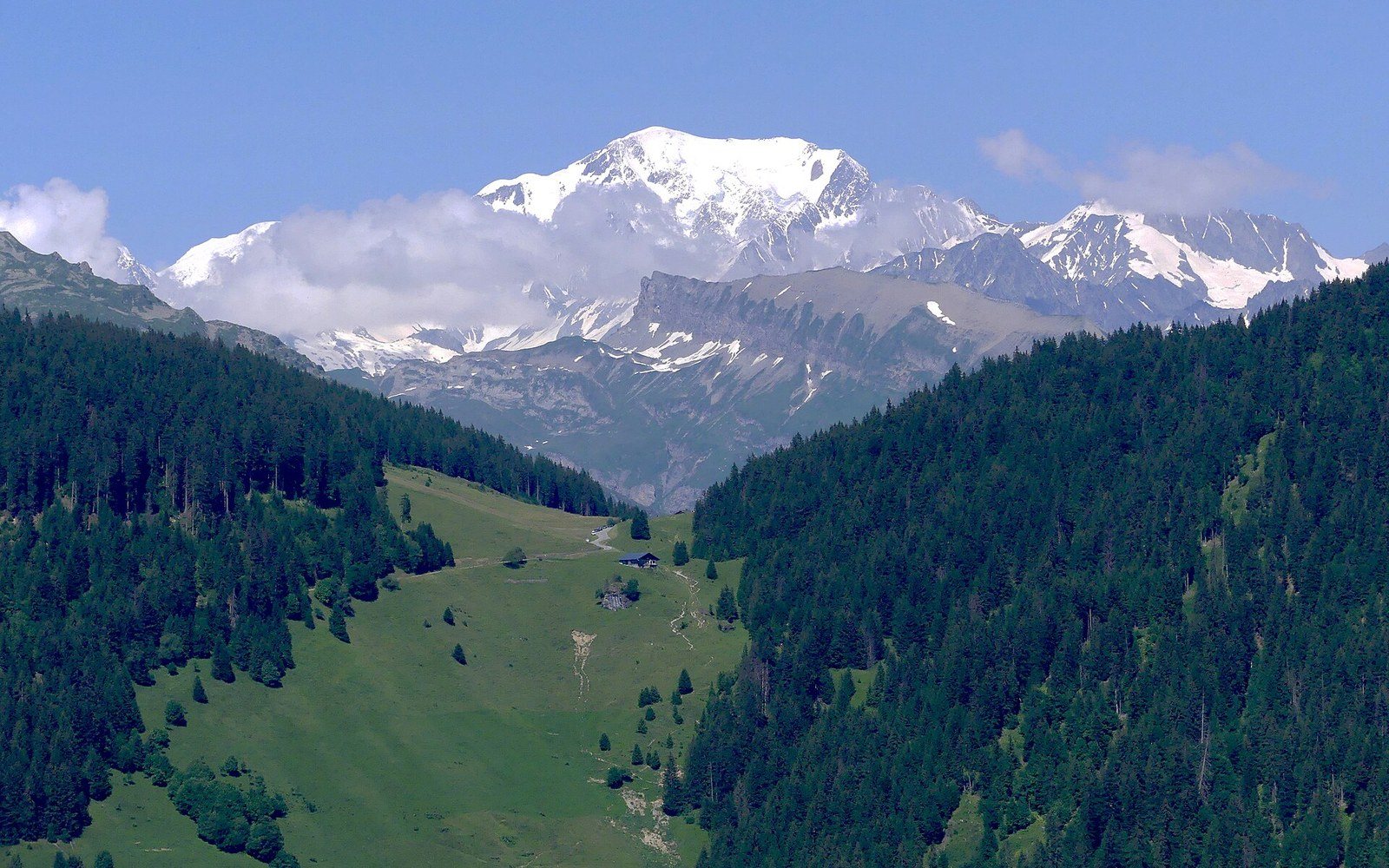
4,808 m. Balmat and Paccard went up on 8 August 1786 and came back down.
Photo: Col du Pré et Mont-Blanc depuis plateau de Cuvy en été (juillet 2024) 2 · Wikimedia Commons
A Roman road is the one claim with solid material evidence. Paving stones, milestone fragments and survey alignments consistent with Roman construction technique have been identified along the Col's approaches, and the pass appears in the ancient record as one of the routes connecting the Po plain with the Rhône corridor. The Romans called the crossing Alpis Graia — the Greek Alps — which itself suggests use long before imperial administration formalised it. The road served both military movement and the commercial traffic that followed it. Whether it was engineered under the Republic or the Empire remains imprecise, but its existence as a documented Roman axis is not seriously in dispute.
The Arc has cut its bed so deep that road and rail compete for the same ledge.
Photo: Guilherme Rossi / Pexels
Bernard and the Hospice
The religious settlement at the col is harder to date cleanly. Bernard de Menthon, the Augustinian canon from whom both Saint-Bernard passes take their name, is the traditional founder of hospices on the high Alpine routes, and his establishment on the Grand Saint-Bernard is better documented than any corresponding foundation on the Petit. Tradition assigns him to the tenth or eleventh century; hagiographic sources place his death in 1081, though even that figure is not universally accepted. The hospice on the Petit Saint-Bernard — a refuge maintained for centuries to shelter travellers and pilgrims crossing the pass — exists as a physical fact, but the precise moment of its founding and the degree of Bernard's personal involvement remain matters of ecclesiastical tradition rather than archival record. What is clear is that by the medieval period a functioning religious house stood at the col, providing the kind of institutional hospitality that the great Alpine passes required. The current building dates from repeated reconstructions, the most recent of significance carried out in the nineteenth century.
A stone circle of uncertain date and purpose stands near the summit — known locally as the Lovia, its function has generated speculation ranging from Gaulish ritual use to Roman surveying practice. No excavation has produced a definitive answer.
Hannibal's Ghost
The most argued claim is also the least settled. The question of which pass Hannibal used when he brought his Carthaginian army, elephants included, across the Alps into Italy in 218 BCE has occupied scholars, generals and enthusiasts for roughly two thousand years. The ancient sources — principally Polybius and Livy — describe the route with enough geographical detail to be suggestive and enough ambiguity to be useless as proof. The Petit Saint-Bernard has its proponents: the relatively gentle profile of the col, its position as a natural corridor between the Rhône valley and the Po plain, and certain topographic features that some researchers align with Polybius's description of a final descent and a rallying point have all been cited in its favour. Against it stands an equally serious body of argument for the Col du Mont Cenis, the Col du Clapier, and several other candidates. A 2016 study by a multidisciplinary team that examined sediment cores for traces of animal occupation and soil disturbance pointed toward the Col de la Traversette, far to the south — adding a new candidate rather than resolving the debate. No physical evidence yet recovered links Hannibal specifically to the Petit Saint-Bernard.
The pass, in other words, carries the weight of three layered identities: a documented Roman road, a medieval hospice of uncertain founding, and a recurring argument that refuses to close. Each claim reflects something real — the col was used, it was inhabited, it mattered — but the precision of the attribution varies sharply by era. One fact is not in dispute: the road over the Petit Saint-Bernard was paved, maintained and crossed again before anyone thought to write it down.
Chronology
- 218 BCEHannibal's Alpine crossing (ancient sources: Polybius, Livy); route unresolved
- Alpis Graiaattested Roman road on the col's alignment; precise construction date disputed
- c. 1081traditional death date of Bernard de Menthon, conventional founder of Alpine hospices
- Medieval periodfunctioning hospice recorded at the col; repeated reconstructions follow
- 19th centurymost recent significant rebuilding of the hospice structure
- 2016multidisciplinary sediment study points to Col de la Traversette for Hannibal's route, not Petit Saint-Bernard