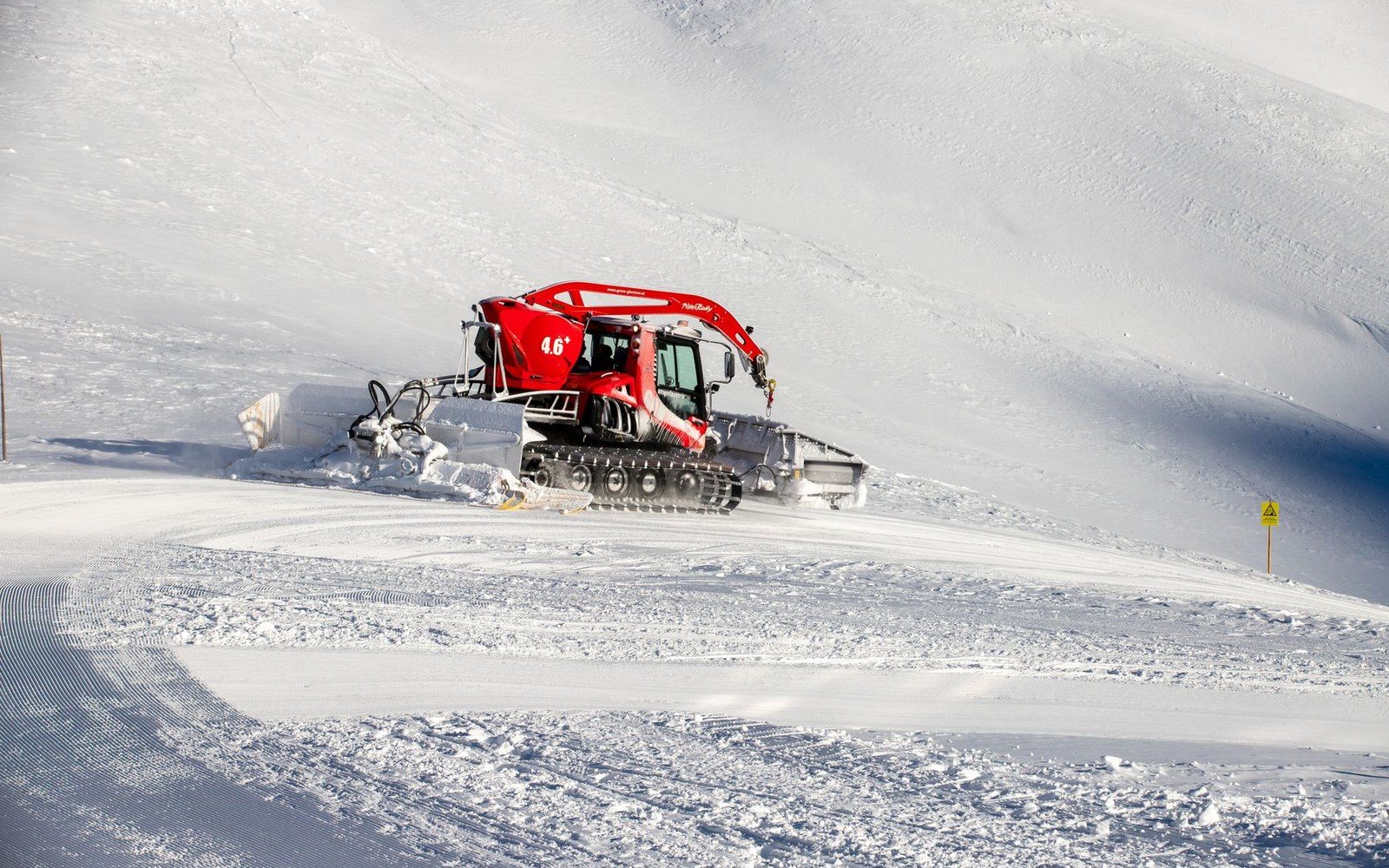
Every lance on the piste is an intake somewhere lower down the mountain.
Photo: Alan Kabeš / Pexels
The Water Behind the Snowgun
Where the Water Goes When the Resort Opens
A modern high-volume snow lance — the cannon-shaped fixture bolted to a steel mast above a piste — moves anywhere from a few to around thirty cubic metres of water per hour depending on nozzle configuration and ambient temperature. Over a full night of production, a single gun can draw a volume of water comparable to a small community's daily use. A large ski domain may operate several hundred guns simultaneously during a production window.
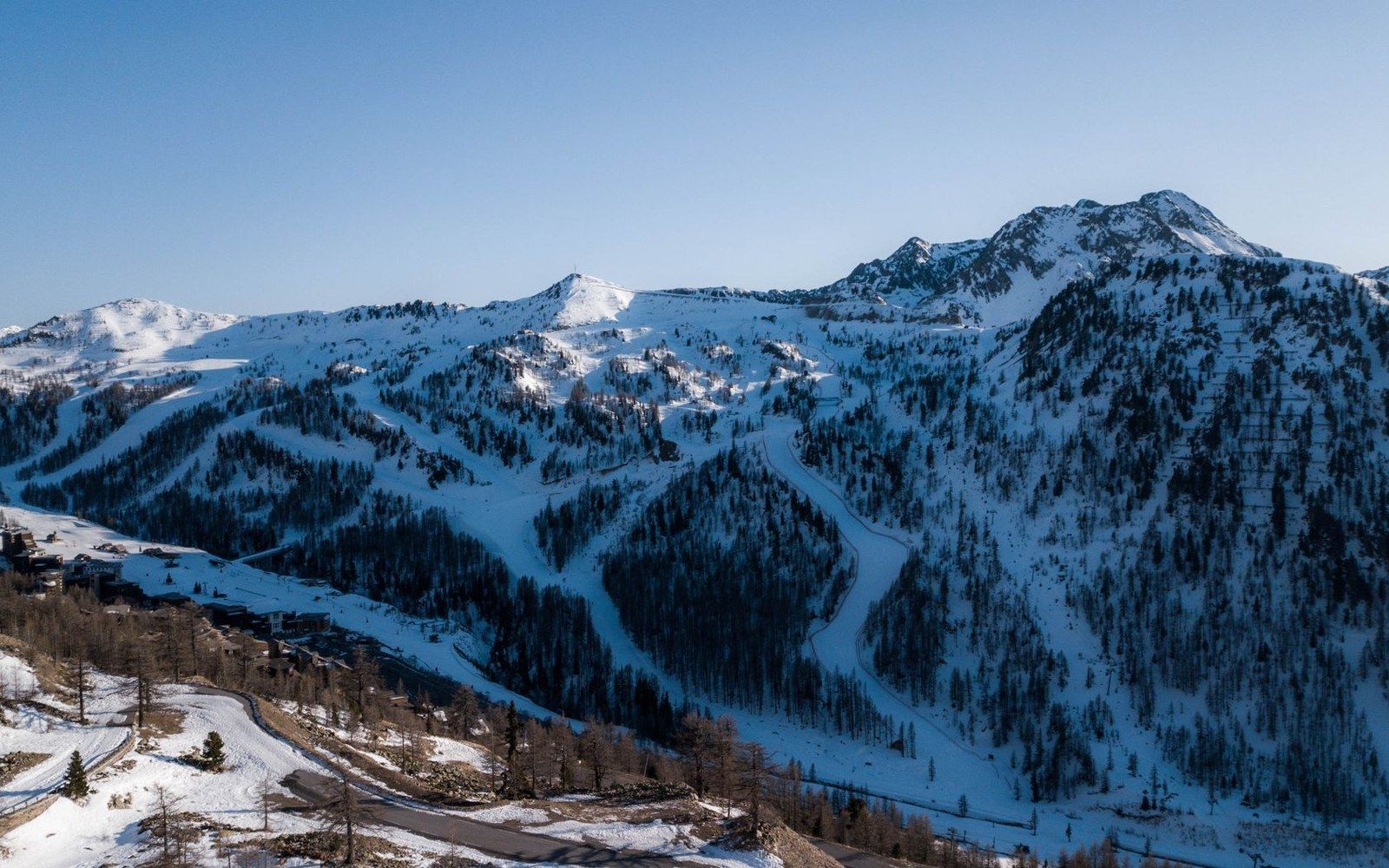
Built from the lift line outward: a Plan Neige resort starts at its infrastructure.
Photo: Gaetan THURIN / Pexels
The water does not come from a tap. Every serious Savoyard resort runs a dedicated high-altitude reservoir — a retenue collinaire, or off-stream storage pond — built into the terrain above the snow-making network. Val Thorens, at 2,300 metres in the upper Tarentaise, draws from a reservoir fed by summer snowmelt and maintained at altitude precisely so that the gravitational head reduces the pumping energy needed to deliver water to the guns. Snowmaking water volumes and reservoir infrastructure are catalogued in France's national water authority database ↗, the SANDRE system, which logs abstraction points and permitted volumes for each installation.
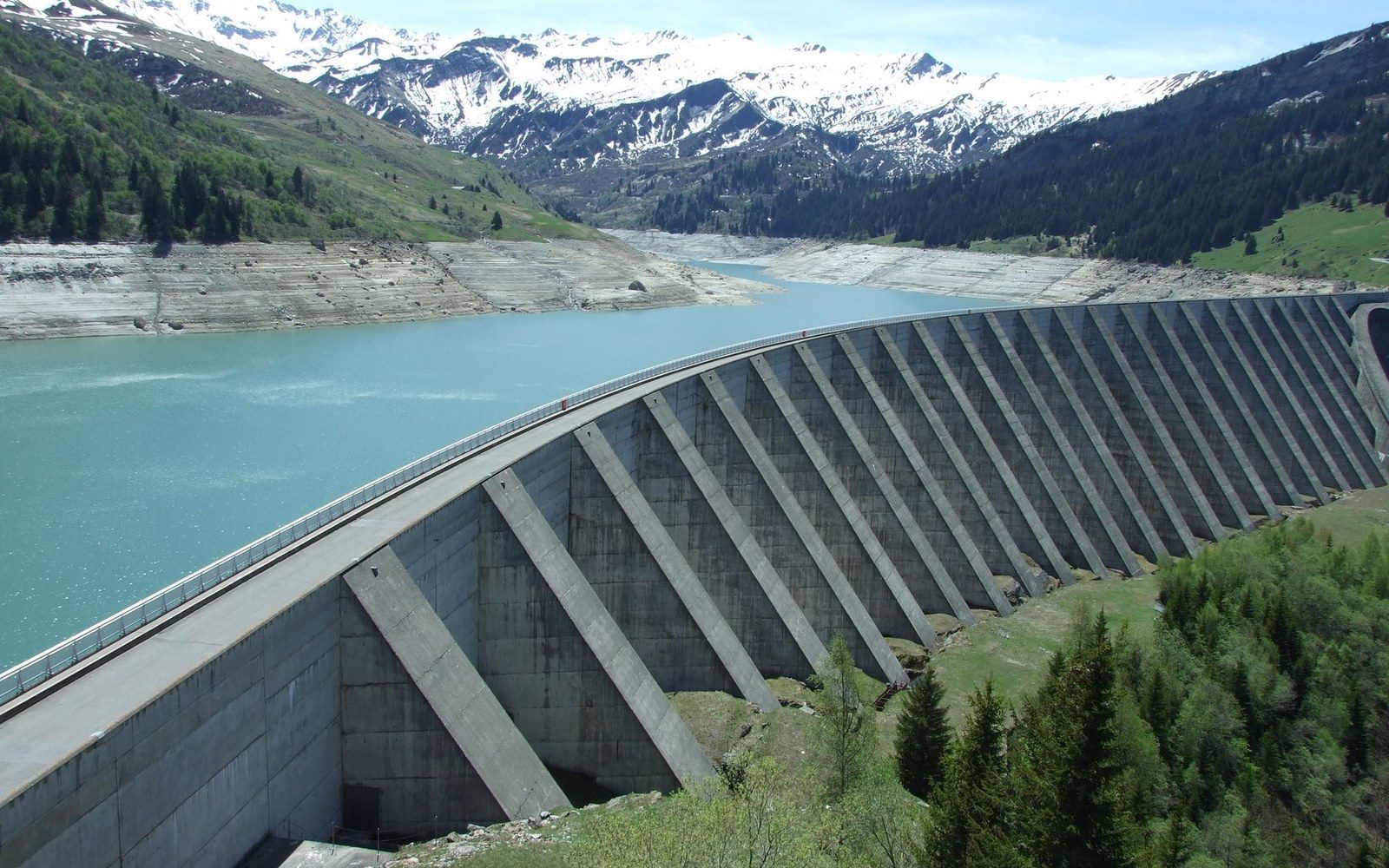
The Chevril wall stands 180 m. The old village is behind it, under the water.
Photo: ciboulette / Pexels
The intake altitude matters for two reasons. First, water temperature at elevation stays closer to zero degrees Celsius, which is the threshold at which nucleation — the conversion of water droplets to ice crystals in the gun's air stream — becomes efficient. Second, the higher the reservoir relative to the piste network, the more potential energy is available, reducing the electrical load on the pump stations that push water through insulated buried pipelines to each hydrant point on the mountain.
In the Maurienne, the Col de la Croix de Fer corridor and the Albiez-Montrond area draw from catchments at between 1,500 and 1,800 metres. The installed pipe networks for snow-making systems of this scale typically run from two to several dozen kilometres, depending on the domain's vertical spread. France's environmental code, updated under the Loi sur l'Eau framework, requires operators to demonstrate that summer abstraction volumes do not compromise minimum ecological flows in the source streams — a condition assessed by the Agences de l'Eau at each basin level.
The guns themselves require compressed air as well as water; a compressor network, usually housed in a valley-level plant room, runs in parallel with the water circuit. The energy cost is substantial: French ski operators have reported figures in the range of 1–2 kilowatt-hours per cubic metre of artificial snow produced ↗, a figure that varies with wet-bulb temperature, altitude and equipment generation. At those consumption levels, the economics of snow-making are inseparable from the cost of electricity — which, in a valley where Électricité de France's hydroelectric infrastructure lines the Arc and its tributaries, means the energy loop closes within the same watershed that supplies the water.
How the system works
| — | Retenue collinaire — an off-stream storage pond, built at altitude to gravity-feed the snow-making network below it |
|---|---|
| — | Nucleation — the conversion of water droplets to ice crystals in the gun's air stream; most efficient near 0 °C |
| — | Wet-bulb temperature — the temperature measure (combining air temperature and humidity) that determines whether snow production is viable on a given night |
| — | Hydrant point — the connection in the buried pipe network where a snow lance or cannon is attached |